Then Who Am I?
Eighteen months ago I stood on a stage and told a room full of people I hated network automation.
I meant it. I wasn't being cute. I wasn't playing a character. I was the guy who'd spent eight months in Cisco NetAcad and fifteen hours a week learning the CLI. I was the guy working four maintenance windows a week, studying for the NP at night, chasing a cloud cert on top of that, with little kids at home wondering where their dad went. Somebody would say "automation," and I'd feel my jaw tighten.
Last month I built a website with a repo on GitHub. People can open issues and send pull requests. I’ve built at least a dozen AI agents to do work for me, leveraging an automation platform I've spent the better part of a year building. These agents act on my behalf, triggered by events, and perform tasks for me. I’m orchestrating complex workflows and as a result, have removed a fair bit of manual toil from my life. I’ve merged enough git branches to qualify as an arborist.
Same guy.
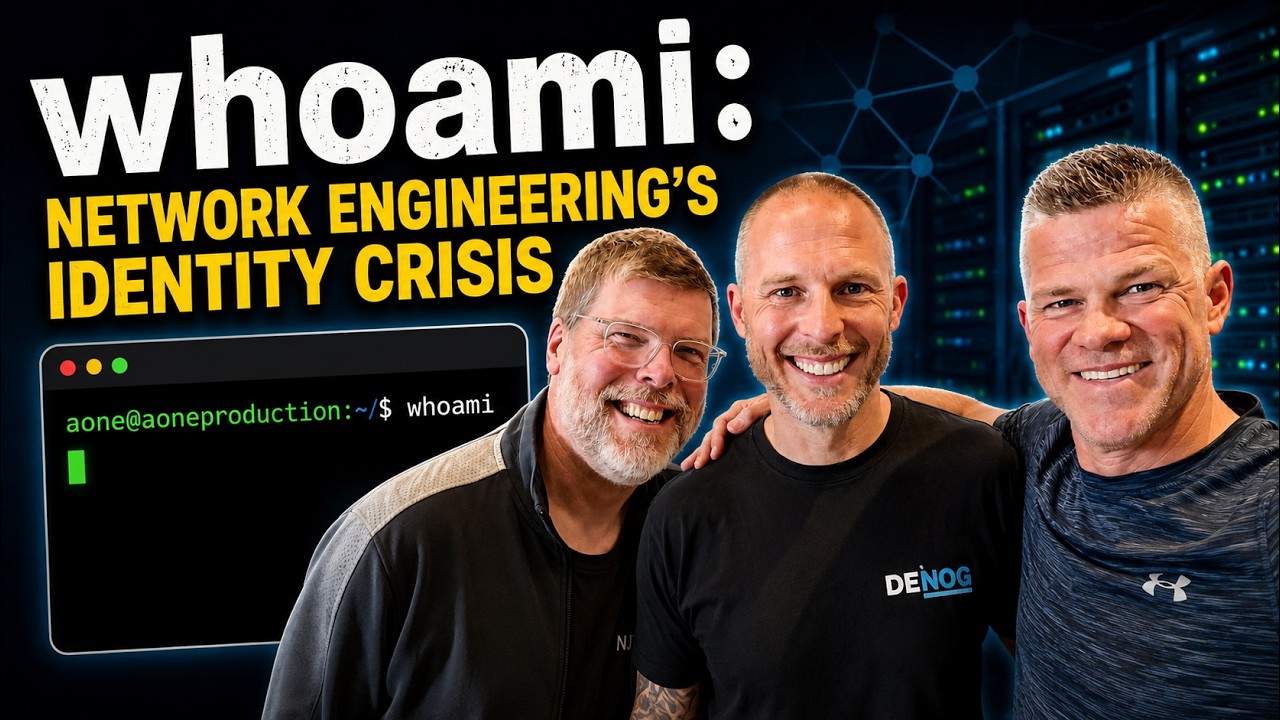
So what changed? I sat down at AutoCon 5 in Munich with Chris Grundemann and Scott Robohn, the two co-founders of the Network Automation Forum, and Chris said something that put a name to the thing I'd been circling for years.
He said what’s driving low rates of network automation adoption isn't the tooling. It's identity.
Let me back up, because that word carries a lot of weight.
The test tells you who you are
Chris walked me through what the CCIE really measures. There's networking knowledge in there, sure. But the test itself, and most of the road that leads to it, is about one thing: how fast can you type CLI commands. Half the day you build. You leave for lunch. They break your network. You come back and the clock is running. How fast can you troubleshoot in the CLI?
The pinnacle. The PhD of network engineering. Timed typing.
"And so of course you get your identity wrapped up in how fast you can type CLI commands," Chris said. "And when somebody comes along and says, you don't have to type CLI commands anymore, you say, well, then who am I?"
Then who am I?
I felt those words in my chest.
I didn't make it to the IE, but I spent what felt like an enormous chunk of my life learning the craft, and the craft was the command line. My whole CCNA. My CCNP years. It wasn't all CLI, but the CLI was the part they tested, the part they timed, the part I bled for. To have someone tell me that's not the future? That isn't a technical disagreement. That's someone reaching into your chest and moving furniture around.
My resistance was never about Python being hard. A buddy of mine, Chris Marget, told me years ago: “if you can write a two-dozen-page Notepad++ script for a maintenance window, that's programming, dude. Python isn't that far off.”
He was right. And I nodded and did nothing about it. I hid from Python until I couldn't.
Not because I was dumb. I'd told myself that story for far too long after failing out of computer science, but that wasn't it.
I hid because learning Python meant admitting the thing I was good at wasn't the whole job anymore. And when you've built your career from one skill, threatening the skill feels like threatening you.
Our CLI addiction
Late in the conversation Chris said the CLI is like any other addiction. No one can quit until they decide it's time.
Scott looked at him like they should end the podcast right there. Mic drop.
You cannot argue someone out of an identity. Chris compared it to politics. The second the person across from you announces they're the other team, you stop listening. Not because you're stubborn. Because you're protecting yourself. If a network engineer defines who they are through the CLI, their brain cannot hear the next sentence you say.
I know this because I was that engineer. You could not have talked me into automation in 2023. I wasn't available to be talked into it.
So what moved me?
Not a pitch. Nobody won an argument with me. My identity was pulverized by life, a layoff, and a long stretch of unemployment. It changed me. Deeply. When you rebuild, you get to choose what goes in. That's a brutal way to arrive. I don't recommend the path. But that's how I got here.
And the softer answer, the one that scales to people who haven't been leveled by circumstance, is what Chris and Scott are building.
A watering hole, not a lecture
When I asked how you compel people to change, Scott said you don't. You can't compel anybody. What you can do is build the watering hole. Keep the seats clean. Make sure there are enough of them.
I love that, because it's honest about the limits of persuasion. NAF started with two guys and their opinions. They set a target of 200 people for AutoCon Zero and 345 showed up. There was demand, and all Chris and Scott did was dust off the chairs.
The one question that hasn't changed since Zero: why haven't we seen full adoption of network automation? Chris said the tagline stays until we see the full adoption.
When I said automation saves us time, Chris pushed back on that hard. “Automation doesn't save you time,” he said. “You still work your eight hours. It reallocates time. The question is what you spend those hours on. Babysitting an upgrade you've done a hundred times, or the architecture, the capacity planning, the actual thinking.”
Scott ended with stellar advice: “You don't have to become a programmer to operate a network. I'll never be a carpenter, but I know how to swing a hammer. Learn the tools.” We get to keep all of our networking knowledge, and we never have to learn another vendor OS again. Just Python. Instead of the syntax of every box ever made.
Which one is easier?
I stood on their stage and told 900 people I hated this. Now I've got a repo where strangers send me pull requests. I use automation everyday. I use coding agents everyday. I build new AI agents weekly to continue coordinating the complexity and mundane drudgery of my professional endeavors.
I couldn't do it until I did. And now I can. So can you.
Go listen to the episode with Chris and Scott. They’re doing great work and changing lives in the process. They’ve both helped me change my life and career, and for that I am eternally grateful.
/Andy
Listen or watch the full episode with Chris Grundemann and Scott Robohn:
- On the AONE website (Apple, Spotify, and every podcast app)
- On YouTube
Connect with the guests and their work: