
The CCNA Gets You the Interview. What Gets You the Job?
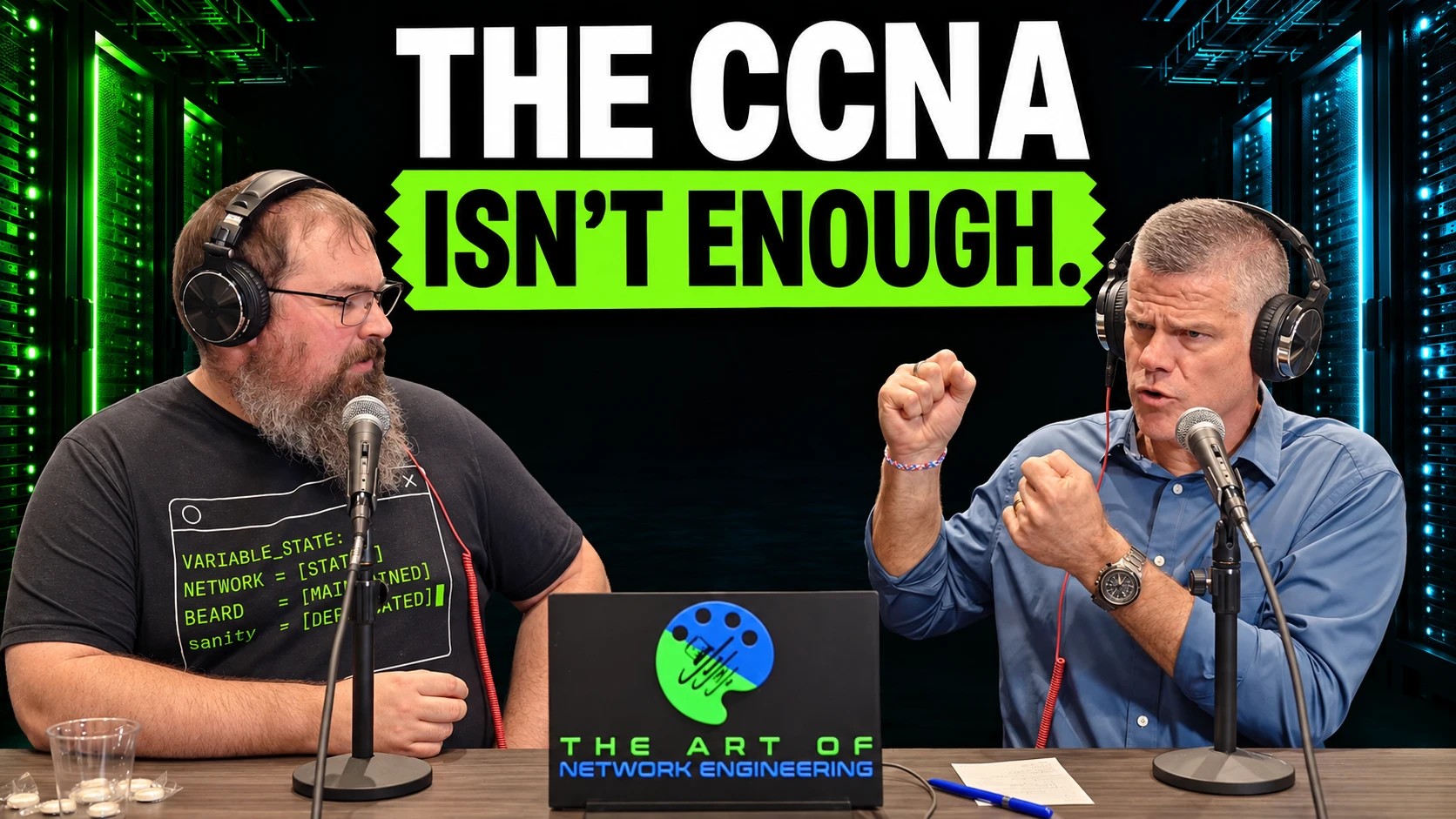
How the hell do you become a network engineer in 2026?
The Advice That Got Me Hired
When I started studying for my CCNA around 2010, the advice was pretty straightforward. Get your CCNA. Build a home lab. Practice until you know what you're doing. Find some way to demonstrate that you can communicate.
I followed that advice. I built a lab with old Cisco equipment, started blogging about what I was learning, and eventually made YouTube videos.
That lab wasn't just configs on a screen. I made my own Ethernet cables, straight-through, crossover, rollover, and when they didn't work, I bought a cable tester and figured out why. One T1 connection taught me something no simulator ever could: it has its own pinout, nothing like the cables I learned in Cisco Networking Academy.
I installed a card in my router just to get more ports. I swapped memory in my 2800s. I built a rack and busted my knuckles on rack nuts. I learned the slow stuff nobody puts in a study guide: power management, remote access, cable management, keeping electrical noise out of a run. I taught myself enough Linux to configure my own terminal server, after wasting weeks on crossover cables before I found out it needed rollover.
When I interviewed for networking jobs, people would tell me I didn't have experience.
I had routers. I had switches. I configured routing protocols. I broke things and spent hours troubleshooting them. Sure, my equipment was end-of-life, but I knew how to use it. That lab gave me the confidence to walk into an interview and defend what I knew.
Eventually, someone gave me a shot. Now when I'm asked by newcomers how to get into network engineering, I don't feel like my advice from a few years ago is enough today.
Is the CCNP the New CCNA?
To be clear, the CCNA is still the standard entry-level certification, and it's a great program. But Dakota thinks CCNA holders have flooded the job market. We spent years telling aspiring network engineers to get their CCNA, and they listened. Now hiring managers are looking at piles of resumes from people who followed that advice.
Dakota thinks the CCNP is the new CCNA. Back in the day the advice was, get your CCNA, land a job, build several years experience, then pursue your CCNP. Hiring managers frowned on a CCNP without production experience.
Dakota is the hiring manager at his company, so when I asked if he'd hire a CCNP with no experience, he said "no." The certification isn't enough. But if that same candidate has a CCNP, an extensive home lab, and a YouTube channel documenting their learning journey, now he's very interested. This candidate isn't just saying they understand networking. They show what they know.
Three Routers I Gave Away
This conversation reminded me of someone I worked with years ago. He was struggling technically, and I thought a home lab might help him get comfortable with routing and switching. I had three Cisco 2620XM routers sitting in my rack, my first routers, the ones I'd spent countless hours learning on. So I pulled them out, drove about an hour, and gave them to him. Free.
He put them in his trunk. He never powered them on.
I still think about that sometimes. Not because everyone needs physical equipment. Dakota and I both love physical labs, but we recognize that money and space can be legitimate obstacles, and Packet Tracer and EVE-NG are useful tools. There's just something about plugging in a cable, troubleshooting a physical connection, and figuring out why your equipment isn't behaving that teaches lessons a simulator might not.
But those three routers weren't really the point. I'd given someone an opportunity to practice. He didn't take it.
He Hadn't Even Left the Parking Lot
Dakota was interviewing for his first job in IT. Toward the end of the interview, he asked a question he recommends to people today: was there anything he could do before the next interview to become a stronger candidate?
The interviewer mentioned that the organization used Cisco Meraki. At the time, Cisco offered free Meraki equipment through certain webinars. Dakota hadn't even left the parking lot before he was signing up.
He eventually got a firewall, switch, and access point, then integrated all three into his home network. He learned the equipment, configured protocols, built redundancy, and studied the topology. When he returned for his next interview, he explained everything he'd done.
The interview was incredibly short. Why? Because he'd already started doing the work they wanted to hire him for.
I love that story. Not because everyone needs to chase free equipment or spend every waking hour studying, but because Dakota asked what the employer needed, listened to the answer, and did something about it. He turned an interview into a demonstration. From a hiring manager's perspective, that's pretty compelling.
What Are We Looking For?
At one point, I asked Dakota what makes someone stand out when he's hiring. He talked about communication skills, teamwork, and the willingness to keep learning. His organization has about 25 people, so bringing someone onto the team isn't simply a matter of checking technical boxes. They need to work well with everyone else.
A candidate who can explain their home lab, teach something on YouTube, or discuss a mistake they've made gives him information a certification can't. Can they communicate? Can they learn? Can they work through problems?
And something else came up repeatedly. Hunger.
My wife played college basketball on a full scholarship. She has a saying I've always loved: "You can't teach hustle." Some players dive onto the hardwood for a loose ball. Others don't. Dakota and I kept coming back to that same idea.
If we're looking for people who want to learn, what are we doing to help them?
Where Do We Find These People?
I've got three home labs sitting in my basement that I'd love to give away. I've given away equipment before, and the problem isn't finding people who want free stuff. Trust me, announce a giveaway on YouTube and you'll find plenty. The problem is finding someone who could genuinely benefit from it: someone who wants to learn but can't afford equipment, someone trying to change careers, someone who just needs an opportunity.
I asked Dakota how he'd approach that. His answer was mentorship.
Dakota pointed out that not everyone needs a home lab right now. Someone brand new to IT might benefit more from starting on a help desk, learning foundational skills, and working toward networking. Someone else might already have the technical knowledge but need help interviewing. You can't solve those two problems with the same advice. You need to understand the person.
Can You Charge for Helping People?
Dakota created the IT Career Accelerator to connect people seeking IT careers with mentors who've worked in the industry, including hiring managers. And he charges for it.
I'll admit, that brought up some feelings for me. I've spent years creating free content and answering questions from people trying to get into networking. The Art of Network Engineering has always been about helping people. So when I hear about paid career programs, part of me gets uncomfortable. We've all seen the expensive boot camps promising to turn someone into an engineer practically overnight.
But Dakota described something different. His program has paid coaching, a free community tier, and scholarships for people who can't afford access. He also pays the coaches for their time.
That last part matters, because something I've been wrestling with is how to keep helping people when there are only so many hours in a day. Every hour I spend answering messages or working on content is an hour I'm not spending with my family. I love doing this, but time isn't unlimited.
He even built an asynchronous video coaching system so students can send questions and receive personalized video responses from their coaches. He told me he's tracked the outcomes of free and paid coaching, and that people who paid were more likely to follow through and report progress. He didn't have the exact numbers available during our conversation, so I won't pretend we established some universal rule about paid advice.
But his experience raised an interesting question: does putting something into your own development change how seriously you take it? I've certainly experienced that. Putting money and years of effort into Cisco NetAcad kept me in it until I finished. Meanwhile, I've started and abandoned a pile of free Python courses.
Money isn't the only way to demonstrate commitment. But commitment has to show up somewhere.
The People Already in the Industry Have a Part to Play
Toward the end of our conversation, I found myself thinking about how I got here. I was a cable guy. I spent years climbing poles, installing equipment, and wondering what happened beyond the cable modem. I wanted to understand the CMTS. Then the switching. Then the routing. I wanted to climb the OSI stack.
But I didn't know many network engineers. Eventually, I attended a career fair where someone encouraged me to connect with networking professionals online. So I did. And people helped me. They answered questions. They shared advice. They gave me opportunities to learn.
Dakota challenged experienced engineers to find someone interested in networking and help them along. Maybe that's through a college. Maybe it's LinkedIn. Maybe it's a local user group. Maybe it's someone working a job completely unrelated to IT who doesn't realize network engineering is even an option. I recently spent part of an airport rideshare talking with my driver about getting into technology. I have no idea whether he'll pursue it, but I remember being the guy who didn't know where to start, and I remember what happened when someone pointed me in the right direction.
Dakota's right that aspiring engineers need to put in the work. The CCNA is still worth pursuing. Labs still matter. Communication still matters.
But there's something both sides of the hiring table can do. Candidates can stop waiting for permission to start learning. And those of us already working in networking can make it a little easier for them to find their way.
Someone gave us a shot. Now it's our turn to recognize who's ready for one.
Listen to the full conversation with Dakota Snow on The Art of Network Engineering or watch it on YouTube.