
From Network Engineering to Product Marketing: The Career Path More Engineers Should Consider
For a lot of network engineers, the career arc feels predetermined. Help desk to NOC, NOC to operations, operations to architecture, and then, somewhere along the way, burnout. You spend years surviving outages and maintenance windows and the kind of pressure that comes with touching production systems that thousands, sometimes millions, of people depend on. It can feel like the only direction left is up the same ladder, into roles that have most of the same weight and none of the relief.
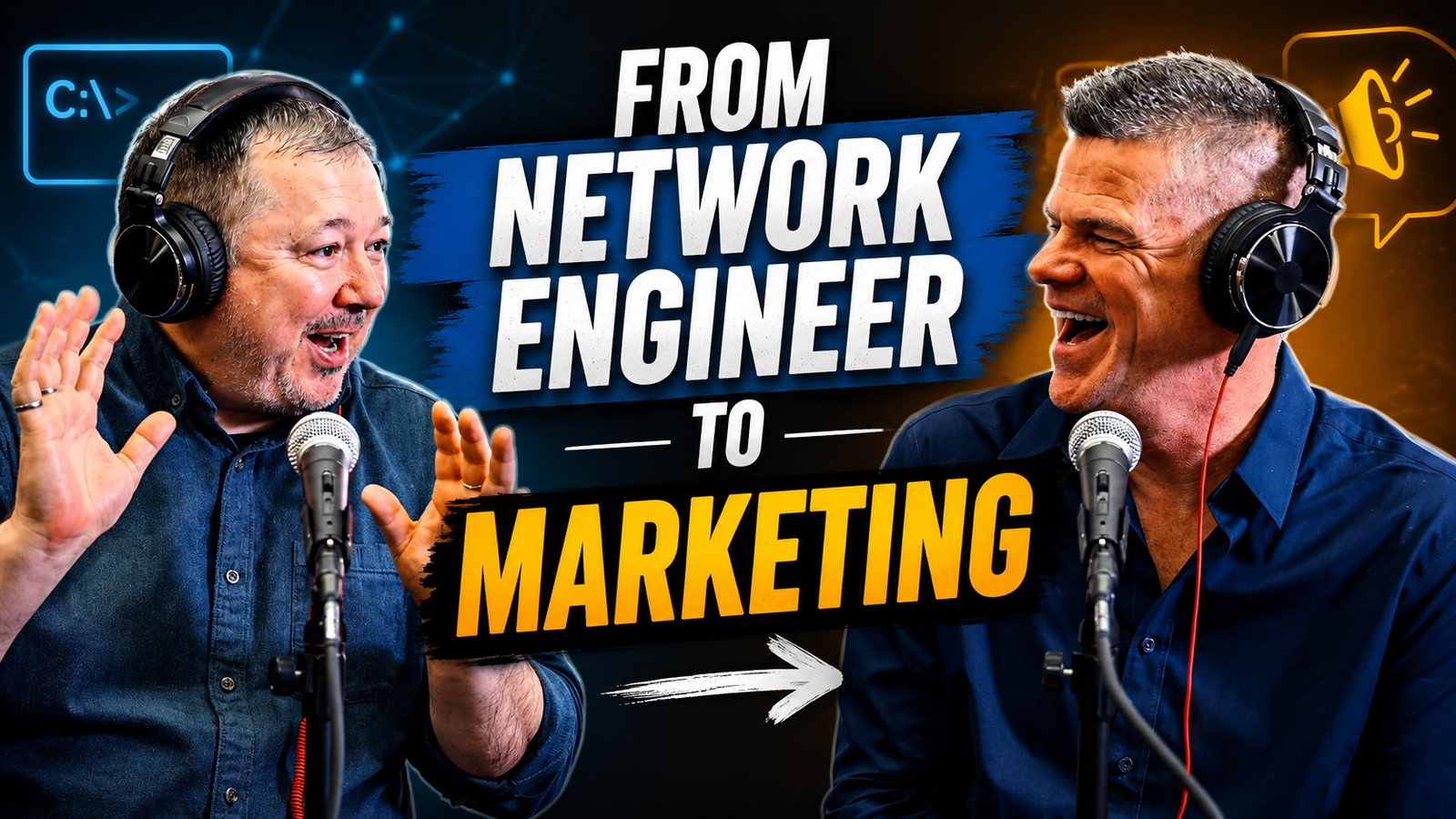
There is another path. In a recent episode of The Art of Network Engineering, Andy Lapteff sat down with Patrick McCabe to talk about the move from network engineering into vendor-side product marketing.
The reality of operational networking
Patrick told a story from his early days supporting a massive carrier network. A debug session on a set of ATM switches ended with someone accidentally powering off a core during a maintenance window. It's the kind of moment that sticks with you for the rest of your career, and if you've worked in operations long enough, you know exactly what it feels like. Every maintenance window is a small bet. Every change is a slightly bigger one. Every outage leaves a mark.
"You press that button, and you don't know what's going to happen."
That was Andy, joking but not really. The hard part of operational work isn't any single bad night. It's the way the pressure compounds over years. Most engineers who eventually want out don't lose their love of the technology. They lose their tolerance for being the person who has to be right at 3 a.m.
Vendor-side roles
Most engineers can name the obvious tracks without thinking about it: operations, architecture, consulting, cloud. Far fewer have a clear picture of the vendor-side seats that sit right next to those. Roles like Systems Engineer (SE), Technical Marketing Engineer (TME), product marketing, developer relations, and product management are well paid, technically deep in their own way, and largely invisible from the operations side of the fence. The work looks different from running a network, but it doesn't ask you to throw away the technical experience you spent a decade building. You're still in the weeds, you're just in different weeds. You influence what gets built, you teach, you create things, and your weekends start belonging to you again.
Patrick's path into vendor work ran through years of technical support and systems engineering before he ever sat down with a marketer. Andy's path was almost the opposite. Product marketing turned out to be the first role that actually leaned on the things he was already best at: communication, storytelling, translating between engineers and humans, and producing content that people actually wanted to consume. Two different on-ramps, same destination, and both started with realizing the destination existed in the first place.
Product marketing is not "just marketing"
The biggest misconception engineers carry about product marketing is the belief that knowing the technology is enough to do it well. It isn't. Product marketing is its own discipline, and the mindset gap between deep technical work and effective messaging is bigger than most engineers expect when they cross over.
Engineers default to detail. How a thing works, how to configure it, what every knob does. Marketing has to abstract above all of that. The job is to take a complex product and turn it into a story that resonates with a buyer, supports the sales team, differentiates the product from its competitors, and connects to a business problem the customer is already trying to solve. That's a different kind of writing, a different kind of thinking, and a different kind of meeting.
Patrick told a great story about writing his first "white paper" after the transition. He produced a hundred-page technical design guide. Technically accurate? Absolutely. Useful as marketing collateral? Not really. That moment captures the shift every engineer has to make when they cross over. You stop explaining how the technology works and start explaining why it matters.
Soft skills become career multipliers
The other thread that kept coming up was communication. Patrick was clear that his technical ability alone didn't unlock the roles he wanted. What unlocked them was a less glamorous skill set: communication, humility, listening, building relationships, and connecting with people as people instead of as tickets. The technology got him in the conversation. Everything else determined whether he was invited back.
This is the lesson most senior engineers eventually arrive at, usually the hard way. Technical skill gets you into the room, and communication is what determines how far you go once you're there. For anyone who wants to expand beyond purely operational work, deliberately investing in how you write, speak, and explain things is one of the highest-leverage things you can do, whether that takes the shape of a blog, a YouTube channel, a meetup talk, mentoring a junior, or just getting better at translating a technical idea into plain English on a call.
Leveraging AI
The episode also got into AI and automation, but neither Andy nor Patrick framed AI as something that's about to replace engineers wholesale. The framing was leverage. Engineers who learn to use AI well are going to outperform engineers who don't, and that's true whether the work in question is automating network changes, troubleshooting a weird outage, writing documentation, producing content, or doing product marketing. The tools are different in each case. The pattern is the same: the engineer who has them in their hands moves faster and produces better work than the one who doesn't.
As Andy put it, the people most at risk of being replaced by AI probably aren't engineers. They're engineers who chose not to use AI.
The bigger career question
A lot of engineers eventually figure out that they enjoy teaching, communicating, influencing, mentoring, or shaping strategy more than they enjoy the next midnight page. Vendor-side careers offer a path that still leverages years of technical experience while opening up an entirely different kind of day-to-day, one where the trade-offs are different and, for some people, much better suited to who they actually are.
Not everyone will want that path, and that's fine. But more engineers should at least know it exists.
Listen, watch, and stay in the loop
If today's conversation hit home, the full episode is the best place to go next. If you want to keep talking about this with other engineers, our It's All About the Journey Discord community is free and full of people at every stage of the career, from "just heard about networking" to triple-CCIE.
- Watch: youtu.be/iFeuGTa5zu8
- Listen: buzzsprout.com/2127872/episodes/19353059
- All links: artofnetworkengineering.com
- Discord: artofnetworkengineering.com/iaatj
Subscribe in your favorite app so you don't miss the next one, and if this post got you thinking about a career move, share it with the teammate who's been quietly wondering whether there's a path that isn't another rung on the same ladder.