AI Isn't Coming for Network Engineers. It's Coming for the 2 A.M. Outages
Ask ten software developers whether they use AI, and you'll probably get ten variations of the same answer: "Of course." Ask ten network engineers the same question, and you'll hear something very different: "Not on my production network."
That difference isn't because network engineers are behind the times. It's because the stakes are different. When a developer writes bad code, Git usually saves the day. When a network engineer makes the wrong change, entire businesses stop running.
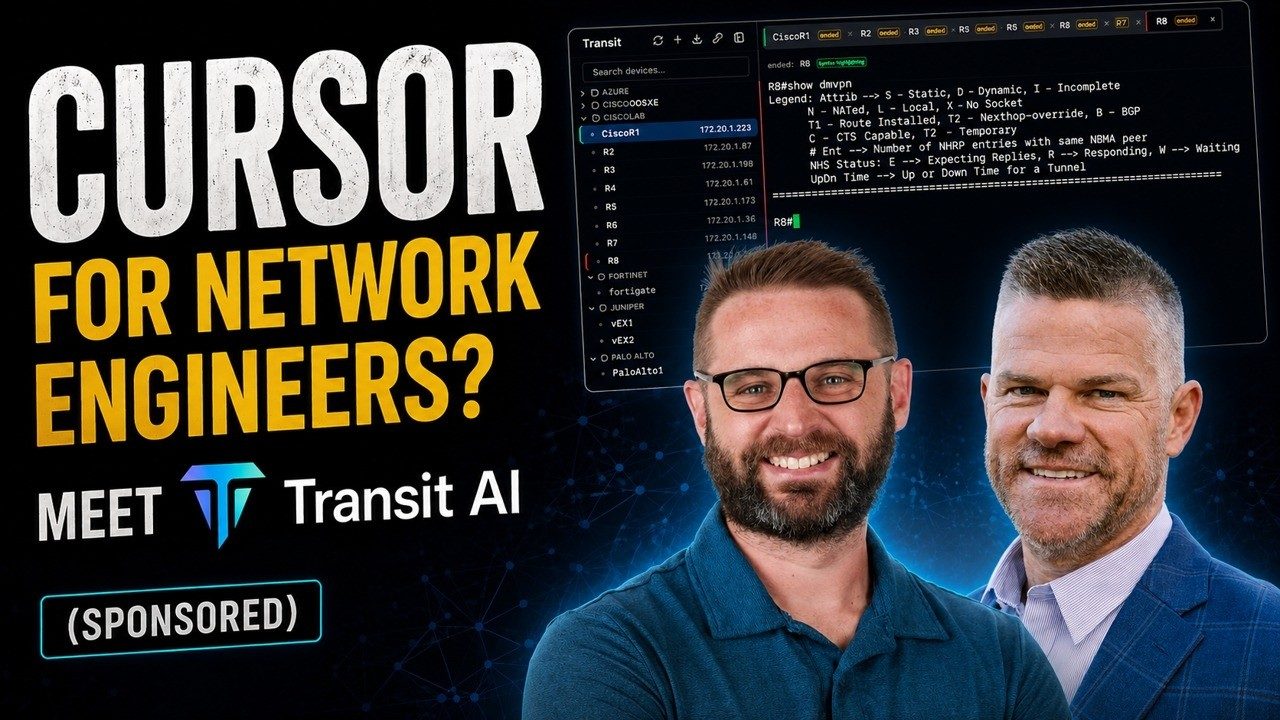
That's where this sponsored episode with long-time friend of the show Knox Hutchinson starts. Knox built an AI-assisted SSH client designed specifically for network engineers. But our conversation wasn't about another AI product. It was about trust.
Why Network Engineers Are Right to Be Skeptical
The networking industry has spent decades learning one lesson: production doesn't forgive mistakes. So it tracks that engineers treat "let the AI change it" with suspicion. Unlike many AI coding assistants that can freely modify source code, Transit AI was intentionally designed around investigation rather than automation. It can gather evidence, correlate information across devices, summarize findings, and help engineers troubleshoot, but it can't make configuration changes.
That one design decision led to the biggest discussion of the episode: AI shouldn't replace network engineers, it should reduce their cognitive load.
The Biggest Bottleneck Isn't Technology
Networking isn't short on difficult problems, it's short on experienced people. Senior engineers are buried in escalations while junior engineers often lack the confidence, or the permissions, to investigate complex issues, and the result is slower incident resolution, longer outages, and growing technical debt.
Now imagine a junior engineer who could quickly and effectively investigate a service incident, collect the evidence, generate a concise summary, and hand a senior engineer a concise report that points at the likely root cause.
A Live Demo
The moment that landed hardest was a live demo. Knox pointed Transit AI at a multi-router DMVPN issue, and in under a minute it worked the problem the way an expert engineer would.
Transit AI:
- Identified which routers were participating in the overlay
- Collected operational data using show commands
- Correlated the findings across multiple devices
- Flagged two separate configuration issues
- Produced a human-readable summary for escalation
The engineer stayed in control the entire time. That distinction, assist instead of act, is the point.
The Future Isn't AI vs. Engineers
The most interesting takeaway was the realization that software developers and network engineers are approaching AI from completely different places. Developers largely settled the question of whether to use it years ago, while network engineers are still working out how to use it safely. That is what makes this conversation valuable, because eventually every network team lands on the same question: if AI could safely take hours of repetitive investigation off your plate without ever touching production, would you let it?
Watch (or listen) to the episode:
Cursor for Network Engineers? Meet Transit AI (Sponsored)
If you're curious about where AI fits into network operations, not the hype but the reality, this is a conversation worth hearing.