
446 Decisions
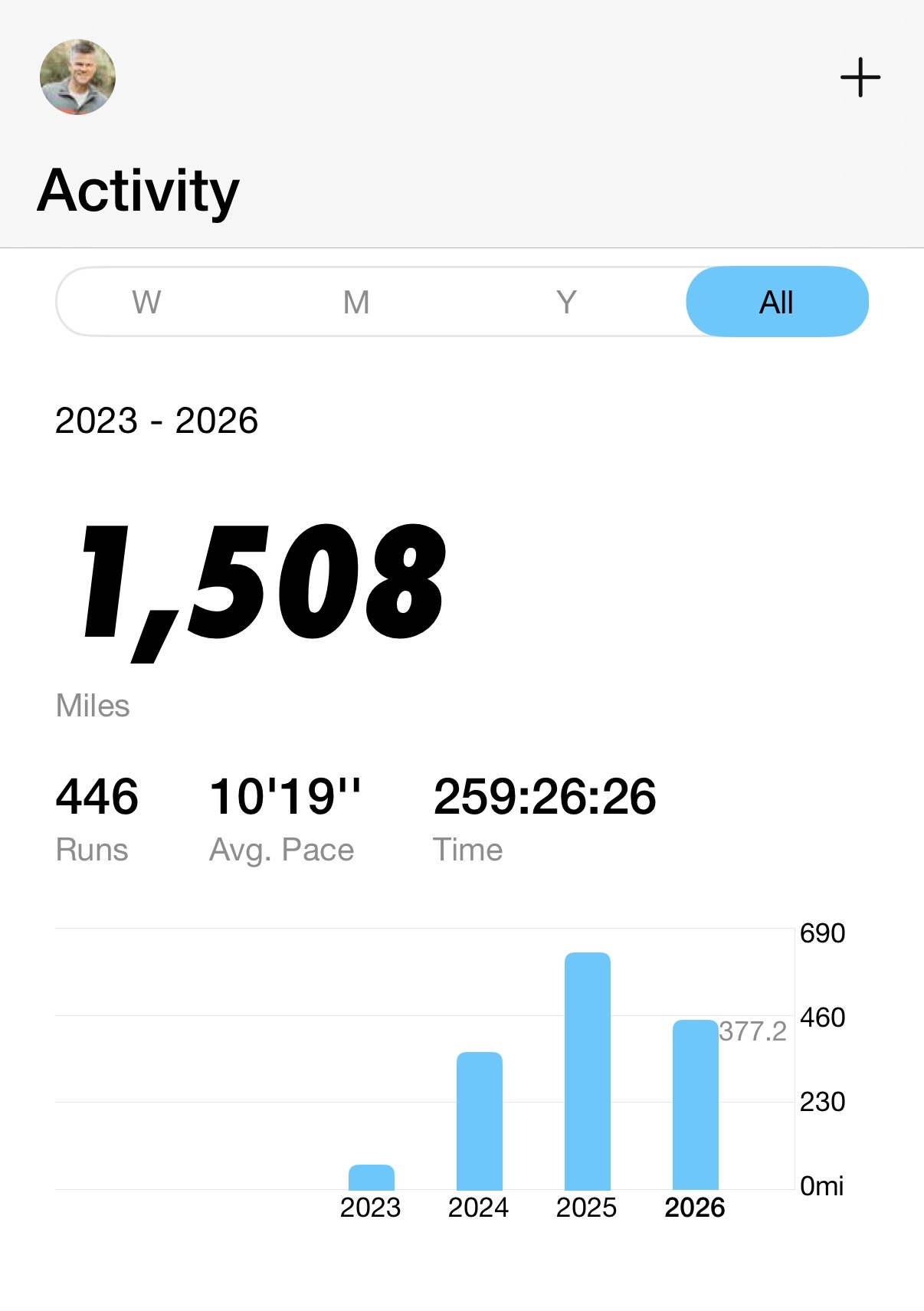
I started writing this blog post after run number 446.
I just finished 5.5 miles in San Diego. It wasn't a race. I didn't set a PR. Nobody was waiting at the finish line. It was just a run. Post run, cooling down in my hotel room overlooking the San Diego Bay, I opened Nike Run Club to review my stats.
1,508 miles, more than 259 hours, over 446 runs.
446 times I laced up my sneakers and ran.
446 decisions that became over 1,500 running miles logged.
Damn good results for a non-runner.
I wasn't a runner
I stopped running decades ago. I accumulated enough back and knee injuries that I accepted my running days were over. Not "I'm taking some time off," or "Maybe I'll get back into it someday." I stopped thinking of running as something available to me. I wasn't a runner anymore.
Then I got laid off in December 2023. I was depressed. I was anxious. I wasn't handling it well. I was coming apart emotionally. There was a morning I thought about pulling the covers up over my head and hiding in bed. I didn't want to feel what I was feeling and I knew sleep was one such escape. I'd been in this awful place decades before, and I knew where that road led. It's not good. I remembered back in the day, running made me feel better. It changed my emotional state, cleared my mind, and created space between my problems and my reality. Problems that felt enormous before a run often felt smaller afterward.
So I got out of bed and I ran. Then I ran again.
In 2023, I logged 69 miles. In 2024, my first full year back, I ran 364.3 miles at an average pace of 13:11 per mile. In 2025, I ran 626.7 miles, and my average pace was 9:13. Almost four minutes per mile faster.
There was no dramatic breakthrough. No Rocky montage. No personal trainer. Just a lot of runs.
Compound Interest
There's a powerful concept my olympic medalist crew coaches taught me in high school: get 1% better every day. James Clear wrote about it in Atomic Habits. Similar ideas show up as continuous improvement, compounding improvement, kaizen, or the aggregation of marginal gains.
The math is seductive. Improve something by 1%, then improve the improved version by another 1%, and keep compounding those gains. The incremental gains are imperceptibly slow for a long period of time, but with consistent effort and discipline, the growth is remarkable.
I didn't become 1% faster every time I ran. Sometimes I got slower. Sometimes I got injured. Sometimes I missed days. Sometimes I worked hard for weeks and appeared to make no progress whatsoever.
The 1% idea is useful, but not because human performance follows a smooth exponential curve. The important part is the accumulation.
A three-mile run barely matters. A single hour learning Python barely matters. One sales call barely matters. One page of writing barely matters. But the reps change the person performing them. The runner on run 449 is not working with the same body as the runner on run 1. The developer making commit 600 is not attacking a problem with the same mental models as the person making commit 1.
That is where compounding happens. Not in the output. In you.
Belief
A few years ago, if you asked me if I could run four miles at an 8:54 pace, I would have laughed in your face. Not because I thought it would be difficult. Because I believed it was impossible. Those days were behind me. I wasn't 17 anymore.
For years I held a mental model that said running was no longer something my body could do. So I didn't run. And because I didn't run, I never produced evidence that the model might be wrong. My belief reinforced my behavior.
Then I was forced to confront my mental model, and violate my beliefs. So I ran. My body didn't explode. So I ran again. And again. Each run created a small piece of evidence that didn't fit the story I told myself for decades. Eventually the evidence became more convincing than the old story.
That process has a name in psychology that is much more useful than "believe in yourself." Self-efficacy. Psychologist Albert Bandura used the term to describe our belief in our ability to perform a particular behavior or accomplish a particular task. It matters because self-efficacy affects whether we begin, how much effort we put in, and whether we persist when things get difficult. And one of the strongest sources of self-efficacy is something Bandura called mastery experience. Basically: you do the thing successfully. Your brain gets evidence. That evidence changes what you believe you're capable of doing next.
That sounds almost embarrassingly obvious until you compare it with the way we often approach confidence. We tell people to believe in themselves. Think positively. Visualize success. Have the right mindset.
Maybe. But there's another route. Do something. Get a little evidence. Do it again. Get more evidence. You can act your way into a belief that you could never talk yourself into.
Fake it
"Fake it till you make it" and "act as if" are mantras chanted in 12 step programs. They direct folks to behave like the person they are trying to become. You don't pretend you're an expert. You start doing what an expert-in-training would do.
You speak even though you don't feel like a speaker. You write even though you don't feel like a writer. You lead before the word "leader" feels comfortable. You build software while still thinking, "I'm not really a developer."
Evidence of change appears. Reality begins contradicting your self-limiting core beliefs.
That happened to me with software. Two years ago, I couldn't spell Git. I understood technology. I'd spent most of my career around networks and infrastructure. But software development belonged to software developers, and I wasn't one.
Then I started solving little problems. I wrote a Python script. Then another. Something needed data from an API, so I figured out APIs. I needed somewhere to keep code, so I got more comfortable with Git. Something needed to run automatically, so I learned cron. Then Linux. Databases. Testing. CI. Cloud deployment. Vector databases. Retrieval. Every project exposed another thing I didn't know, so I learned enough to solve the next problem.
The first commit in the software stack I'm building was May 2 of this year. Nineteen weeks later I have 165 Python scripts running in production, 56 scheduled jobs, 104 test files, six Git repositories and roughly 600 commits. I built a Next.js website with 19 pages and 145 blog posts, its own CI pipeline and a Cloudflare deployment. I built two lead-gen apps. An executive assistant. A subnetting game I built during an AONE episode. A knowledge base with more than 14,000 embedded passages. There are APIs, databases, automation systems, tests and a truly impressive number of things I have broken along the way.
I'm not listing all of that because I think it makes me a great software engineer. It doesn't. I'm listing them because it makes my old sentence, "I'm not a developer," difficult to defend.
At what point does evidence overrule identity?
Identity
A 2025 meta-analysis looking at habit and identity across health behaviors found a strong relationship between the two. Importantly, the researchers noted that the relationship may not be one-way. Identity can influence behavior, but repeated behavior may also reinforce identity.
That distinction is huge. We tend to think identity comes first. "I am a runner, therefore I run." "I am a writer, therefore I write." "I am a leader, therefore I lead." Sometimes it probably does. But the reverse is just as interesting. I run. Then I run again. I accumulate enough evidence that "I am a runner" starts feeling true. And once the identity changes, behavior changes.
That may be where friction evaporates. Compare these two thoughts:
"I'd like to run more."
"I'm a runner."
The first one contains a negotiation. Should I run today? Do I have time? What's the weather like? Am I tired? Can I do it tomorrow? The second one narrows the decision tree. What does a runner do? A runner runs.
That doesn't mean identity magically eliminates discomfort. I still have days when I don't want to run. But identity changes the default. Running no longer feels like an isolated activity I periodically choose. It is something I do because it fits the person I believe myself to be.
That is powerful. And potentially dangerous if the identity is wrong.
"I'm not technical." "I hate exercise." "I'm bad with money." "I'm terrible at public speaking." "I'm not creative." "I'm not leadership material."
Those statements sound descriptive. But once we adopt them as identity, they can start making decisions for us. They close doors before we ever test them. For decades, "I can't run" did exactly that. The way out was evidence.
I think that's one reason fake-it-till-you-make-it can work when it's used correctly. You temporarily borrow the behavior before you own the identity. Then you let reality decide whether the identity fits.
Sunday-night me versus Monday-morning me
This is where consistency becomes more effective than discipline. We talk about disciplined people as though they possess some mysterious reservoir of willpower. I'm not convinced. I certainly wasn't motivated for 449 runs. If I required motivation every time, I would have stopped somewhere around 12.
What seems to matter much more is reducing how often you have to make the decision.
Psychologist Peter Gollwitzer's work on implementation intentions is useful here. An implementation intention is basically an if-then plan. Instead of "I'm going to run more," you decide: "After I wake up Monday morning, I put on my running clothes and go." That sounds almost trivial. It isn't. A meta-analysis of 94 independent tests found that these kinds of plans had a medium-to-large effect on goal attainment. The research suggests they work in part because they make the relevant cue easier to recognize and the desired response more automatic.
That gives me a very different way of thinking about discipline. Maybe discipline is partly the ability to stop making the same decision over and over.
The version of me thinking about my goals on Sunday night is different from the version of me lying in bed Monday morning. Sunday-night me thinks running is important. Monday-morning me can produce a shockingly sophisticated argument for another 45 minutes of sleep. If those two guys have to debate every morning, the wrong one is going to win fairly often.
So remove the debate. Decide earlier. Put the shoes where you can see them. Run at the same time. Use the same route if that helps. Make starting cheap.
That idea transfers far beyond exercise. "I need to learn Python" is vague. "Every weekday at 7:00, I spend thirty minutes building something in Python" is executable. "I need to write more" is vague. "I write 500 words before I open email on Tuesday and Thursday" is executable. "I should build my network" is vague. "I contact two people every Friday morning" is executable.
People often treat consistency as a moral quality. Maybe it's better understood as system design. The fewer decisions between intention and action, the fewer places there are for friction to win.
The old, hard things become easy
Repetition makes the work cognitively cheaper.
The first time I used Git, nearly everything required conscious thought. Commands. Branches. Commits. Merges. Where am I? What did I just break? Why is Git angry? Eventually, much of that becomes background. I don't have to devote the same amount of working memory to basic operations, which means I can spend more attention on the actual problem.
That's one of the quieter forms of compounding in learning. The old hard things become easy enough that you can spend your cognitive budget on harder things.
A new network engineer may have to consciously think about CLI syntax. An experienced engineer barely notices the syntax and thinks about the system. A new speaker is trying to remember the next sentence. An experienced speaker can notice whether the audience is confused. A new manager is thinking about how to run the meeting. An experienced manager has enough spare attention to notice who hasn't spoken and why.
That's what expertise begins to feel like from the inside. Not knowing everything. Having more mental capacity available because fewer fundamentals require conscious attention.
This is why repetition can create nonlinear returns even though people don't literally get 1% better every day. Run number 449 is not run number 1 plus 448 identical repetitions. Each previous repetition changed the system doing the next one.
The same thing happens with software. Script 165 was not written by the same beginner who wrote script 1. That person already encountered problems, debugged failures, learned tools, built mental models and developed pattern recognition. The next problem was being attacked by a more capable me.
Do progressively hard things, repetitively
This is also why merely showing up isn't enough. You can repeat the same easy thing forever without improving very much.
Research on deliberate practice makes that point pretty clearly. A major meta-analysis found that deliberate practice explained meaningful differences in performance across domains, but far less than the popular version of the "10,000-hour rule" would suggest. Practice matters. So do the quality of practice, feedback, difficulty, prior ability, environment and other factors.
The useful takeaway is not "put in enough hours and greatness is inevitable." It's that repetition needs an edge. Something slightly beyond what you can already do.
That happened to me with software. Every useful project eventually drags me into something I don't know. Authentication. Databases. CI. Async code. Cloud deployment. Vector search. Testing. Reliability. The uncomfortable part is usually the curriculum.
Running works the same way. At one point three miles was difficult. Then it became normal. Eventually normal stops producing the same adaptation. You go farther. Or faster. Or uphill. You stress the system enough that it has a reason to change.
Keep coming back
One of the classic real-world habit studies followed people who chose a behavior and repeated it in the same context. The time required for the behavior to approach automaticity varied enormously, from 18 days to 254 days among participants whose data fit the researchers' model. There is no magic 21-day habit rule. But the result I like even more is that missing one opportunity did not destroy the process.
That matters because streaks can fool us into thinking consistency means perfection. It doesn't. If consistency means never missing, everybody eventually fails. A more useful definition might be: come back.
Miss a run. Come back.
Take a week off. Come back.
Get hurt. Recover. Come back.
Stop writing. Open the document again.
Abandon the project. Decide whether it still matters. If it does, come back.
That is probably why I'm still running despite injuries. It isn't because I maintained some beautiful uninterrupted streak. I didn't. It's because stopping temporarily never became the same thing as quitting. There's a difference.
I think careers work in a similar way. People get knocked sideways. Layoffs. Bad managers. Projects that fail. Companies disappear. Skills become obsolete. Life events consume attention. The person who never gets interrupted does not exist. The person who knows how to restart is resilient.
Cross domain compounding
Looking back, getting laid off in 2023 is an almost absurd example. At the time it felt like my life was disrupted. It was. But that disruption pushed me to run again. Running made me feel better. Feeling better changed how I thought. Thinking more clearly made problems feel more solvable. Feeling capable made me take more action. Those actions produced new evidence. The evidence changed what I believed about myself. That affected my next set of actions.
The compounding effect wasn't isolated to one domain. Exercise affected cognition and mood. That affected work. Work created mastery experiences. Those affected confidence. Confidence increased willingness to attempt harder things. Harder things produced new skills. New skills expanded the range of problems I could solve.
A large 2024 review in BMJ found that several forms of exercise, including walking and jogging, reduced depressive symptoms across randomized trials. Exercise is not a universal substitute for treatment, but the relationship between physical activity and mental health is substantial.
Start with evidence
The more I explore my experience, the less convinced I am of "mindset" as the keystone to achieving goals. Mindset matters. But telling someone to change their mindset is mostly useless advice. What if they can't? What if they genuinely don't believe they can?
I didn't believe I could run. I didn't believe I was a software developer. Trying to force those beliefs would have been a waste of time and effort by a well meaning friend.
Action gave me another path. Do something small enough that your current identity cannot prevent you from attempting it. Then let the outcome become evidence. If the outcome contradicts your old model, pay attention. Repeat. Eventually enough evidence accumulates that the model updates.
You don't have to begin with "I am a runner." You can begin with "I'm going to run today." Do that enough times and one day the language changes without you forcing it. "I run." Then: "I'm a runner."
That last transition matters, because identity reduces friction. The question stops being whether you should behave that way. The behavior becomes congruent with who you are.
I think that's what people are really chasing when they talk about consistency. Not endless acts of heroic discipline. A point where the desired behavior becomes the normal behavior. Where going for the run requires less internal debate than skipping it. Where writing feels stranger than not writing. Where solving technical problems is simply part of how you operate. Where the identity starts carrying some of the load.
But you don't declare that identity into existence. You earn it with evidence.
Receipts
I started writing this piece after run 446. Before I finished it, there was 447. Then 448. Today I went out again. Run 449 was 4.05 miles with 221 feet of climbing. My average pace was 8:54. In my first full year back, my average pace was 13:11.
I know comparing one run to a full-year average isn't an apples-to-apples performance comparison. That's not why I care about the number. I care because the guy who averaged 13:11 would have considered an 8:54 pace impossible. The guy who thought he couldn't run at all would have considered the entire conversation ridiculous.
Nothing dramatic happened between those versions of me. There were just more days. More miles. More decisions.
The same thing happened with software. One Python script didn't change my identity. Neither did ten. Eventually there were 165 scripts, 56 scheduled jobs, six repos and roughly 600 commits. Those numbers aren't magic either. They're receipts. Evidence that the work happened. Evidence that I'm not the same person who started.
So if there's a formula, it's less inspirational than I had hoped. Pick something that matters enough that you're willing to keep returning to it. Make the first action small enough that you can complete it. Decide in advance when and where it happens. Reduce the opportunities to negotiate with yourself. Witness the evidence.
Miles. Pages. Commits. Calls. Applications. Workouts. Whatever represents the behavior you care about.
When the work becomes easy, make it a little harder. When you miss, come back.
And be careful about the identities you use to describe yourself. Especially the negative ones. You may be treating an old data set like a permanent truth. If you want to become something different, you don't need to believe the new story yet. Start collecting evidence for it. One piece. Then another. Then another.
At some point you may notice that the argument inside your head changes. You aren't trying to convince yourself that you can do the thing anymore. You know you can. You've done it too many times to claim otherwise.
That may be what "fake it till you make it" really means. You behave like the person before you completely believe you are the person. Then you keep going long enough for reality to overwhelm belief.
Or maybe it's the other way around. Maybe reality changes first, and eventually your identity catches up with the evidence.
I'm at 449 decisions now. Eventually, if my body cooperates, there will be 500. I doubt run 500 will feel particularly profound while I'm doing it. Most of them don't.
That's the point. The decisions that change your life rarely look life-changing when you make them. They look like putting on your sneakers. Opening your laptop. Writing the page. Making the call. Submitting the application. Having the conversation. Trying something you're not yet convinced you can do.
And then doing it again.
Eventually you stop saying you're trying to become that person. You look at the evidence and realize you already are.
/Andy